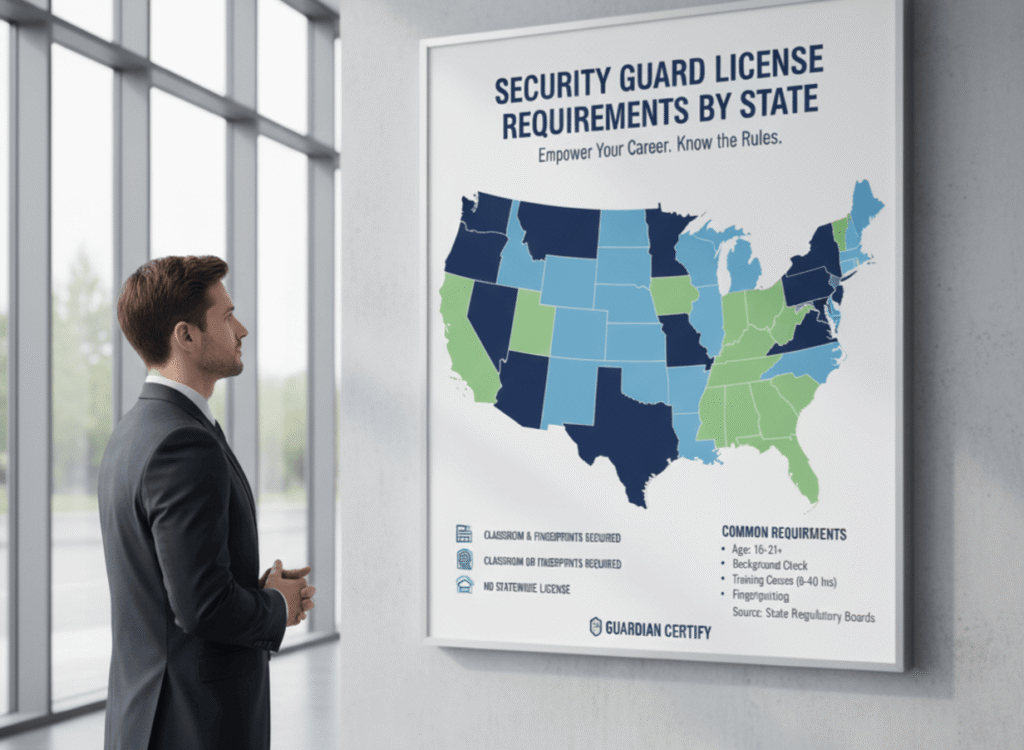
Getting a security guard license can feel overwhelming—especially when every state has different rules, training hours, and fees. Whether you’re looking to work in California, Texas, Florida, or anywhere else in the U.S., understanding state-specific requirements is your first step toward a rewarding career in private security.
This comprehensive guide breaks down security guard licensing requirements for all 50 states, including training mandates, application processes, costs, and renewal timelines. We’ll also cover the differences between unarmed and armed licenses, background check requirements, and common penalties for non-compliance.
By the end of this guide, you’ll know exactly what it takes to become a licensed security professional in your state—and how to maintain that license for years to come.
Understanding Security Guard Licensing in the United States
Security guard licensing exists to protect the public and ensure that individuals working in security roles meet minimum standards of competency, trustworthiness, and professionalism. Unlike some professions with federal oversight, security guard licensing is primarily regulated at the state level—and in some cases, at the city or county level.
This means the path to becoming a licensed security guard in California looks very different from the process in Texas, Florida, or New York. Some states require extensive pre-assignment training and psychological evaluations, while others have minimal requirements or no state-level licensing at all.
Why Licensing Matters
Holding a valid security guard license demonstrates that you’ve:
- Passed a comprehensive background check
- Completed required training in security protocols, legal limitations, and emergency response
- Met age, education, and physical requirements
- Been fingerprinted and cleared through state and federal databases
For employers, hiring licensed guards reduces liability and ensures compliance with state regulations. For clients, it provides peace of mind knowing trained professionals protect their property and people.
If you’re considering a career in the security industry, particularly in California where regulations are strict, understanding these licensing requirements is essential. Many security professionals start as unarmed security guards before advancing to armed positions or specialized roles.
Types of Security Guard Licenses
Before diving into state-specific requirements, it’s important to understand the main categories of security guard licenses available across the United States.
1. Unarmed Security Guard License
This is the most common type of security license. It authorizes individuals to work in security roles without carrying firearms. Unarmed guards typically perform duties such as:
- Access control and visitor management
- Surveillance and monitoring
- Incident reporting
- Patrol and property checks
- Customer service and assistance
Training requirements: Generally range from 4 to 42 hours depending on the state.
Best for: Entry-level security professionals, retail security, event security, residential guards, and corporate lobbies.
2. Armed Security Guard License
Armed guards are authorized to carry firearms while on duty. This license requires significantly more training than unarmed positions and often includes:
- Firearms safety and handling
- Marksmanship and range qualification
- Legal use of force
- De-escalation techniques
- Weapon retention
Training requirements: Typically 12 to 47 hours of firearms-specific training, plus unarmed guard training.
Best for: High-risk environments such as banks, jewelry stores, cash transport, government facilities, and executive protection.
Many professionals who provide armed security guard services must renew their firearms qualifications annually or semi-annually to maintain their licenses.
3. Specialized Security Licenses
Some states offer additional license categories for specialized roles:
- Level-based licenses: States like Texas and New Mexico use tiered systems (Level I, II, III, etc.) with increasing responsibilities and training requirements.
- Class-based licenses: Florida uses Class D (unarmed) and Class G (armed) designations.
- Commissioned officers: Some states offer special commissions for security professionals working in specific industries like healthcare or education.
- Personal protection specialists: Also known as bodyguards or executive protection officers, these professionals typically need advanced training and licensing.
4. Proprietary vs. Contract Guards
It’s also important to understand the difference between:
- Proprietary guards: Security personnel employed directly by a company to protect that company’s assets (e.g., a retail store hiring its own security team).
- Contract guards: Security professionals employed by a security agency and assigned to work at client locations.
Some states have different licensing requirements depending on whether you’re working as a proprietary or contract guard. In Arizona, for example, proprietary guards working directly for a company may not need a license, while contract guards assigned by an agency do.
Common Licensing Requirements Across States
While every state has its own specific regulations, most security guard licensing systems share several common requirements. Understanding these baseline standards will help you prepare for the application process regardless of where you plan to work.
1. Minimum Age Requirements
Most states require: 18 years old for unarmed positions Some states require: 21 years old for armed positions Exceptions: A few states allow 17-year-olds to work in security with parental consent or under specific conditions.
2. Background Checks and Criminal History
Background checks are universal across all states that require licensing. These typically include:
- State and federal criminal history checks: Review of felony and misdemeanor convictions
- FBI fingerprint-based checks: National database screening
- Credit history: Some states review financial records to assess reliability
- Employment history: Verification of previous work experience
- Driving record: Especially for mobile patrol or armed positions
Disqualifying factors may include:
- Felony convictions (especially violent crimes or theft)
- Recent misdemeanor convictions
- Domestic violence charges
- Substance abuse issues
- Dishonest conduct or fraud
Some states have “look-back” periods, meaning certain offenses beyond a specified timeframe (e.g., 5 or 10 years) may not automatically disqualify you.
3. Fingerprinting
Fingerprinting is required in nearly every state that licenses security guards. This process:
- Verifies your identity
- Allows law enforcement to conduct comprehensive background checks
- Ensures your records are accurately matched across jurisdictions
Fingerprinting is typically done through authorized vendors like Live Scan (in California) or at designated law enforcement facilities.
4. Pre-Assignment Training
Training requirements vary widely by state but generally include:
Basic unarmed training topics:
- Legal powers and limitations of security guards
- Emergency procedures and first response
- Report writing and documentation
- Communication and customer service
- Observation and surveillance techniques
- Safety and accident prevention
Armed guard training topics:
- Firearms safety fundamentals
- Weapon handling and maintenance
- Legal use of deadly force
- Marksmanship and range qualification
- Weapon retention and disarming techniques
- De-escalation strategies
Training can be completed through state-approved schools, employers (for on-the-job training), or online platforms (where permitted).
5. Continuing Education and Renewal
Most states require security guards to renew their licenses every 1 to 5 years and complete continuing education during that period. This ensures guards stay current on:
- Legal updates and regulation changes
- New security technologies
- Emergency response protocols
- Firearms requalification (for armed guards)
Renewal timelines by state:
- Annual: Ohio, South Carolina
- Every 2 years: California, Florida, Texas, New York, Illinois
- Every 3 years: Hawaii, Maryland
- Every 5 years: Connecticut, Nevada
6. Physical and Mental Health Requirements
Some states require:
- Medical examinations: To ensure candidates can perform physical duties
- Psychological evaluations: Required for armed positions in states like Oklahoma, Texas, and New Mexico
- Drug screening: To verify candidates are substance-free
- Vision and hearing tests: To confirm adequate sensory abilities for security work
7. Application Fees
Licensing fees vary by state but typically range from $25 to $150. Additional costs may include:
- Background check fees: $30–$75
- Fingerprinting fees: $25–$60
- Training course fees: $50–$500+
- Firearms qualification fees: $100–$300
- Renewal fees: Usually lower than initial application fees
Total upfront costs for obtaining a security guard license generally range from $200 to $800 depending on the state and license type.
State-by-State License Requirements (All 50 States)
This section provides a detailed breakdown of security guard licensing requirements for all 50 states. Each entry includes license types, training hours, application processes, renewal timelines, and unique state-specific requirements.
Use this guide to quickly find the information you need for your state or any state where you’re considering working.
1. Alabama
License Types: Unarmed and armed licenses available
Training Requirements:
- Unarmed: 8 hours of pre-assignment training
- Armed: 14 hours of firearms-specific training
Application Process:
- Submit application to Alabama Security Regulatory Board
- Provide fingerprints and pass background check
- Pay application fee: $75
- Renewal: Every 2 years
Unique Requirements:
- Armed guards must qualify with handgun, shotgun, AND rifle
- Employers must maintain training records for 3 years
Estimated Total Cost: $200–$350
Source: Alabama Security Regulatory Board
2. Alaska
License Types: Unarmed and armed licenses available
Training Requirements:
- Unarmed: 8 hours pre-assignment, plus 40 hours on-the-job within 180 days
- Armed: Additional 8 hours of firearms training
Application Process:
- Apply through Alaska Department of Public Safety
- Fingerprints and background check required
- Application fee: $100
- Renewal: Every 2 years with 8 hours of continuing education annually
Unique Requirements:
- Armed guards must demonstrate competence with their specific issued firearm
- Employers must verify on-the-job training completion
Estimated Total Cost: $250–$400
Source: Alaska Department of Public Safety
3. Arizona
License Types: Unarmed and armed licenses available
Training Requirements:
- 8 hours of pre-assignment training for both unarmed and armed
Application Process:
- Submit application to Arizona Department of Public Safety
- Fingerprints and background check
- Application fee: $50
- Renewal: Every 2 years with 8 hours of continuing education
Unique Requirements:
- No license required if working directly for a company (proprietary guards)
- License only required if working for an agency that assigns guards to various client sites
- This makes Arizona unique in its treatment of proprietary vs. contract guards
Estimated Total Cost: $150–$300
Source: Arizona Department of Public Safety
4. Arkansas
License Types: Unarmed (PSO), Armed (CSO), and Armed School Security Officer (CSSO)
Training Requirements:
- PSO (Unarmed): 8 hours
- CSO (Armed): 16 hours firearms training
- CSSO (Armed School Security): 36 hours specialized training
Application Process:
- Apply through Arkansas Board of Private Investigators and Private Security Agencies
- Fingerprints and comprehensive background check (includes sealed/expunged records)
- Application fee: $75
- Renewal: Every 2 years
Unique Requirements:
- Armed officers must complete annual refresher training
- Background checks include ALL arrests and charges, even if sealed or expunged
- CSSO license is specifically for school protection roles
Estimated Total Cost: $200–$450
Source: Arkansas Board of Private Investigators
5. California
License Types: Security guard card (unarmed) with separate firearm permit for armed roles
Training Requirements:
- 40 hours total broken into three phases:
- 8 hours pre-assignment (Power to Arrest course)
- 16 hours on-the-job training within 30 days
- 16 hours additional training within first 6 months
- Annual 8-hour re-certification required
- Armed: Additional firearms training and qualification
Application Process:
- Complete Live Scan fingerprinting at authorized locations
- Submit online application to Bureau of Security and Investigative Services (BSIS)
- Application fee: $55
- Renewal: Every 2 years
Unique Requirements:
- Psychological evaluation required for firearm permit
- Three-part training structure allows guards to start working quickly while completing full training
- One of the most comprehensive training programs in the U.S.
Estimated Total Cost: $300–$600
Source: California Bureau of Security and Investigative Services
If you’re planning to work in California’s capital, you’ll want to familiarize yourself with local security companies offering security guard services in Sacramento and surrounding areas. California’s strict licensing requirements ensure high standards across the state.
6. Colorado
License Types: Licensing handled at city level; requirements vary
Training Requirements: Varies by city (typically 8–16 hours)
Application Process:
- Contact local city clerk or police department
- Requirements differ in Denver, Colorado Springs, Aurora, etc.
- Fees vary by jurisdiction
Unique Requirements:
- No state-level licensing system
- Some cities require physical examinations and medical certificates
- Each municipality sets its own standards
Estimated Total Cost: $100–$400 (varies significantly by city)
Sources: Colorado Springs Police Department / Denver Police Department
7. Connecticut
License Types: Security Officer Certification Identification Card
Training Requirements:
- 8 hours pre-assignment training
- Armed guards: Additional 8-hour firearms course plus annual refresher
Application Process:
- Apply through Connecticut Department of Emergency Services and Public Protection
- Fingerprints and background check
- Application fee: $70
- Renewal: Every 5 years
Unique Requirements:
- One of the longest renewal periods (5 years)
- Armed guards must complete annual firearms refresher training
Estimated Total Cost: $250–$400
Source: Connecticut DESPP
8. Delaware
License Types: Unarmed and armed licenses available
Training Requirements:
- Unarmed: 16 hours pre-assignment training
- Armed: 40 hours firearms training
Application Process:
- Apply through Delaware State Police Professional Licensing Unit
- Fingerprints and background check
- Application fee: $100
- Renewal: Every 2 years with 8 hours continuing education
Unique Requirements:
- Separate training required for batons, pepper spray, and handcuffs
- Each additional weapon/tool requires specific certification
Estimated Total Cost: $300–$500
Source: Delaware State Police
9. Florida
License Types: Class D (unarmed) and Class G (armed)
Training Requirements:
- Class D: 42 hours of training (one of the highest in the U.S.)
- Class G: 28 hours firearms training
Application Process:
- Apply through Florida Department of Agriculture and Consumer Services
- Fingerprints and background check
- Application fee: $75
- Renewal: Every 2 years
Unique Requirements:
- Armed guards require 4 hours of annual firearms requalification
- Florida has some of the most comprehensive unarmed training in the country
- Security officers must complete training through state-approved schools
Estimated Total Cost: $350–$600
Source: Florida Department of Agriculture
10. Georgia
License Types: No license required for unarmed guards; Exposed Weapon Permit required for armed guards
Training Requirements:
- Unarmed: 24 hours (recommended but not required for licensing)
- Armed: 15 hours firearms training
Application Process:
- Unarmed guards: No state registration required
- Armed guards: Apply for Exposed Weapon Permit through Georgia Board of Private Detectives
- Application fee for armed: $100
- Renewal: Annually for armed guards
Unique Requirements:
- One of the few states with no licensing requirement for unarmed security
- Armed guards must complete annual firearms qualification
- Employers set standards for unarmed positions
Estimated Total Cost: $50–$300 (unarmed minimal; armed $300+)
Source: Georgia Board of Private Detectives and Security Agencies
11. Hawaii
License Types: Guard Employee registration required
Training Requirements:
- 8 hours pre-assignment training
Application Process:
- Apply through Hawaii Board of Private Detectives and Guards
- Fingerprints and background check
- Application fee: $50
- Renewal: Every 3 years with 4 hours of continuing education
Unique Requirements:
- Armed guard requirements determined by local law enforcement agencies
- Registration process is relatively straightforward compared to mainland states
Estimated Total Cost: $200–$350
Source: Hawaii Board of Private Detectives and Guards
12. Idaho
License Types: Licensing handled at city level
Training Requirements: Varies by city
Application Process:
- Contact local city clerk’s office in Boise, Idaho Falls, Nampa, etc.
- Requirements and fees vary by jurisdiction
Unique Requirements:
- No state-level licensing system
- Each city establishes its own requirements
Estimated Total Cost: $100–$300 (varies by city)
Sources: City of Boise / Idaho Falls
13. Illinois
License Types: Permanent Employee Registration Card (PERC)
Training Requirements:
- 20 hours pre-assignment training
- 8 hours on-the-job training within 6 months
- Armed guards: 40 hours firearms training
Application Process:
- Apply through Illinois Department of Financial and Professional Regulation
- Fingerprints and background check
- Application fee: $75
- Renewal: Every 2 years with 8 hours of continuing education annually
Unique Requirements:
- Strict penalties: Employers who knowingly hire unlicensed guards can face fines up to $10,000
- PERC card must be carried at all times while on duty
Estimated Total Cost: $300–$500
Source: Illinois IDFPR
14. Indiana
License Types: No individual state license required; employer registration and fingerprinting required
Training Requirements: At employer’s discretion
Application Process:
- Employer submits employee information to Indiana State Police
- Fingerprinting required
- No individual application fee
Unique Requirements:
- Armed guards must be at least 21 years old
- Training standards set by individual employers
- State maintains registry of security personnel
Estimated Total Cost: $50–$150 (primarily fingerprinting)
Source: Indiana Professional Licensing Agency
15. Iowa
License Types: No individual state license required; employer registration required
Training Requirements: At employer’s discretion
Application Process:
- Employer registers employees with Iowa Department of Public Safety
- No individual licensing process
Unique Requirements:
- Armed guards must obtain a permit to carry from their local sheriff
- Employers set their own firearms training standards
- Minimal state oversight
Estimated Total Cost: $50–$200 (permit to carry fees)
Source: Iowa Department of Public Safety
16. Kansas
License Types: Licensing handled at city level
Training Requirements: Varies by city
Application Process:
- Contact local police department in Kansas City, Topeka, Wichita, etc.
- Requirements vary by jurisdiction
Unique Requirements:
- No state-level licensing
- Cities establish individual standards
Estimated Total Cost: $100–$300 (varies by city)
Sources: Kansas City PD / City of Topeka / City of Wichita
17. Kentucky
License Types: License required for guards working for security companies; proprietary guards may need licensing under certain circumstances
Training Requirements: Varies by license type
Application Process:
- Apply through Kentucky Department of Criminal Justice Training
- Requirements vary based on specific license classification
Unique Requirements:
- Contact DOCJT for specific requirements based on your employment situation
- Distinction between contract and proprietary guards
Estimated Total Cost: $200–$400
Source: Kentucky DOCJT
18. Louisiana
License Types: Registration card with various classifications (unarmed, baton, revolver, shotgun, etc.)
Training Requirements:
- 8 hours pre-assignment
- 8 hours within 60 days of employment
- Separate training for each weapon type
Application Process:
- Apply through Louisiana State Board of Private Security Examiners
- Fingerprints and background check
- Application fee: $100
- Renewal: Every 2 years
Unique Requirements:
- Separate training and endorsements required for batons, firearms, and other weapons
- Armed guards require range qualification for specific weapon types
Estimated Total Cost: $250–$450
Source: Louisiana Board of Private Security Examiners
19. Maine
License Types: No individual license; security companies are licensed
Training Requirements: At employer’s discretion
Application Process:
- Employer notifies Maine State Police of all security employees
- Background investigation required within 60 days
Unique Requirements:
- Company licensing model rather than individual licensing
- Employers responsible for vetting and training
Estimated Total Cost: Minimal (employer-covered)
Source: Maine State Police
20. Maryland
License Types: Security Guard Certification required
Training Requirements: At employer’s discretion
Application Process:
- Apply through a licensed security guard agency
- Application processed by Maryland State Police
- Application fee: $50
- Renewal: Every 3 years
Unique Requirements:
- Armed guards require separate “Wear and Carry Permit” from state police
- Must work through licensed agency to obtain certification
Estimated Total Cost: $200–$400
Source: Maryland State Police Licensing Division
21. Massachusetts
License Types: Individual security guard registration required
Training Requirements: At employer’s discretion but must meet state standards
Application Process:
- Employer registers all guard employees with Massachusetts State Police
- Background check required
- Application fee: $75
Unique Requirements:
- Individual registration system through employer
- State sets training standards but employers administer training
Estimated Total Cost: $150–$300
Source: Massachusetts State Police Certification Unit
22. Michigan
License Types: No individual license; security companies licensed
Training Requirements: At employer’s discretion
Application Process:
- Employer registers guards with Michigan LARA
- No individual application
Unique Requirements:
- Company-level licensing model
- Minimal state requirements for individual guards
Estimated Total Cost: Minimal (employer-covered)
Source: Michigan LARA
23. Minnesota
License Types: Unarmed and armed licenses available
Training Requirements:
- 12 hours pre-assignment training
- Armed: Additional firearms training
Application Process:
- Apply through Minnesota Board of Private Detective and Protective Agent Services
- Fingerprints and background check
- Application fee: $100
- Renewal: Every 2 years with 6 hours of continuing education annually
Unique Requirements:
- Armed guards require annual firearms certification
- Comprehensive continuing education requirements
Estimated Total Cost: $300–$500
Source: Minnesota Board of Private Detective and Protective Agent Services
24. Mississippi
License Types: No state license required
Training Requirements: At employer’s discretion
Application Process: None at state level
Unique Requirements:
- Armed guards require firearm permit from Department of Public Safety
- No formal state licensing system for unarmed guards
Estimated Total Cost: $50–$150 (firearm permit only)
Source: Mississippi Department of Public Safety
25. Missouri
License Types: Licensing handled at city level
Training Requirements: Varies by city
Application Process:
- Contact local police department or city hall
- Requirements vary by jurisdiction (St. Louis, Kansas City, Springfield, etc.)
Unique Requirements:
- No state-level licensing
- Each city establishes requirements
Estimated Total Cost: $100–$350 (varies by city)
Source: Columbia Finance Department
26. Montana
License Types: Unarmed and armed licenses available
Training Requirements:
- 16 hours pre-assignment training
- 8 hours annual continuing education
- Armed: Additional firearms training and qualification
Application Process:
- Apply through Montana Board of Private Security
- Fingerprints and background check
- Application fee: $100
- Renewal: Every 2 years
Unique Requirements:
- Relatively high initial training requirement (16 hours)
- Annual continuing education keeps guards current
Estimated Total Cost: $300–$450
Source: Montana Board of Private Security
27. Nebraska
License Types: No state license required
Training Requirements: At employer’s discretion
Application Process: None
Unique Requirements:
- Minimal state regulation
- Employers set all standards
Estimated Total Cost: Minimal
Source: Nebraska Department of Administrative Services
28. Nevada
License Types: Security guard work card required; separate registration for casino security
Training Requirements:
- No training required for general work card
- Casino security training at employer’s discretion
- Armed: 13 hours firearms training with requalification every 6 months
Application Process:
- Apply through Nevada Private Investigators Licensing Board
- Fingerprints and background check
- Application fee: $75
- Renewal: Every 5 years
Unique Requirements:
- Casino security guards require separate registration through Nevada Gaming Control Board
- Armed guards must requalify every 6 months (shortest interval in U.S.)
Estimated Total Cost: $200–$400
Sources: Nevada PILB / Nevada Gaming Control Board
29. New Hampshire
License Types: Individual license for freelance/contract guards; no license if working for licensed company
Training Requirements:
- Up to 10 hours, content at employer’s discretion
Application Process:
- Apply through New Hampshire Department of Safety
- Fingerprints and background check
- Application fee: $50
- Renewal: Every 2 years with up to 10 hours continuing education
Unique Requirements:
- License requirement depends on employment arrangement
- Armed guards require annual firearms qualification
Estimated Total Cost: $150–$350
Source: New Hampshire Department of Safety
30. New Jersey
License Types: Security Officer Certification required
Training Requirements:
- 24 hours pre-assignment training
- 8-hour refresher every 2 years
Application Process:
- Apply through New Jersey State Police
- Fingerprints and background check
- Application fee: $100
- Renewal: Every 2 years
Unique Requirements:
- Armed guards require separate handgun carry permit from local police department
- Comprehensive initial training (24 hours)
Estimated Total Cost: $300–$500
Source: New Jersey State Police
31. New Mexico
License Types: Three levels – Level 1 (unarmed), Level 2 (armed), Level 3 (armored vehicle)
Training Requirements:
- Level 1: 8 hours
- Level 2: 28 hours
- Level 3: 44 hours
- No online training accepted
Application Process:
- Apply through New Mexico Regulation and Licensing Department
- Fingerprints and background check
- Application fees vary by level
- Renewal: Every 2 years with 4 hours continuing education
Unique Requirements:
- Level 3 requires psychological evaluation
- Must score 90% or higher on jurisprudence exam for Level 3
- All training must be in-person
Estimated Total Cost: $250–$600 (increases with level)
Source: New Mexico RLD
32. New York
License Types: Security Guard Registration Card; separate card for armed guards
Training Requirements:
- 8 hours pre-assignment
- 16 hours on-the-job training within 90 days
- 8 hours annual in-service training
- Armed: 47-hour firearms training course (one of the most extensive in U.S.)
Application Process:
- Apply through New York Department of State
- Fingerprints and background check
- Application fee: $100
- Renewal: Every 2 years
Unique Requirements:
- 47-hour armed training is among the most comprehensive nationwide
- Annual in-service training required
- Three-phase training structure similar to California
Estimated Total Cost: $350–$700 (armed significantly higher)
Source: New York Department of State
33. North Carolina
License Types: Private Protective Services License; separate firearm registration for armed guards
Training Requirements:
- 16 hours pre-assignment training
- 12 hours continuing education every 2 years
- Armed: 4-hour firearms course plus range qualification
Application Process:
- Apply through North Carolina Private Protective Services Board
- Fingerprints and background check
- Application fee: $75
- Renewal: Every 2 years
Unique Requirements:
- Biennial continuing education requirement
- Armed guards need separate firearm registration permit
Estimated Total Cost: $250–$450
Source: North Carolina PPSB
34. North Dakota
License Types: Three levels – Apprentice Security Officer, Security Officer, and Commissioned Security Officer; separate firearms permits
Training Requirements: Varies by license level
Application Process:
- Apply through North Dakota Private Investigation and Security Board
- Fingerprints and background check
- Application fees vary by level
- Renewal: Annually on September 30th
Unique Requirements:
- Active law enforcement officers cannot hold a security license
- Tiered licensing system with increasing responsibilities
- Annual renewal (shorter cycle than most states)
Estimated Total Cost: $200–$400
Source: North Dakota PISB
35. Ohio
License Types: No individual license; employer registration required
Training Requirements: At employer’s discretion
Application Process:
- Employer registers guards with Ohio Department of Public Safety
- Annual renewal required
Unique Requirements:
- Armed guards require 20-hour firearms training and Firearm-Bearer Endorsement
- Company-level registration model
Estimated Total Cost: $100–$300 (primarily for armed endorsement)
Source: Ohio Department of Public Safety
36. Oklahoma
License Types: Unarmed and armed licenses available
Training Requirements:
- Unarmed: 40 hours (Phase I and II)
- Armed: Additional 32 hours (Phase IV)
Application Process:
- Apply through Oklahoma CLEET (Council on Law Enforcement Education and Training)
- Fingerprints and background check
- Application fee: $100
- Renewal: Every 2 years with 8 hours continuing education (16 hours for armed)
Unique Requirements:
- Armed guards require psychological evaluation
- Comprehensive training program (40 hours for unarmed is high)
Estimated Total Cost: $400–$700
Source: Oklahoma CLEET
37. Oregon
License Types: Unarmed and armed licenses available
Training Requirements:
- Unarmed: 14 hours
- Armed: 24 hours firearms training
Application Process:
- Apply through Oregon Department of Public Safety Standards and Training
- Fingerprints and background check
- Application fee: $75
- Renewal: Every 2 years with 4 hours continuing education
Unique Requirements:
- Armed guards have additional restrictions regarding mental health history
- Mental health background screening more stringent than many states
Estimated Total Cost: $250–$450
Source: Oregon DPSST
38. Pennsylvania
License Types: No individual license required; employer registration required
Training Requirements: At employer’s discretion
Application Process:
- Guards are certified through Pennsylvania State Police
- Licenses obtained through Department of State after certification
Unique Requirements:
- Armed guards must be certified under the Lethal Weapons Training Act (Act 235)
- Act 235 certification is separate from general employment
Estimated Total Cost: $200–$400 (Act 235 certification)
Source: Pennsylvania Department of State
39. Rhode Island
License Types: No individual license; employer registration required
Training Requirements: At employer’s discretion
Application Process:
- Employer registers guards with Rhode Island State Police
- No individual licensing process
Unique Requirements:
- Armed guards require separate permit from the Attorney General to carry firearms
- Minimal state oversight for unarmed positions
Estimated Total Cost: $100–$300 (armed permit fees)
Source: Rhode Island Attorney General
40. South Carolina
License Types: Security Officer Registration Certificate; separate Security Weapons Permit for armed guards
Training Requirements:
- 4 hours basic training
- 2 hours employer-provided orientation
- Armed: 4 hours firearms training plus range qualification
Application Process:
- Employer applies for license on behalf of guard
- Fingerprints and background check
- Application fee: $50
- Renewal: Annually
Unique Requirements:
- Armed guards can obtain concealed weapons permit for off-duty carry
- Annual renewal cycle (relatively short)
Estimated Total Cost: $150–$350
Source: South Carolina Law Enforcement Division
41. South Dakota
License Types: Licensing handled at city level where regulated; no overall state requirements
Training Requirements: At employer’s discretion
Application Process: Varies by city
Unique Requirements:
- No statewide licensing system
- Some cities have no requirements at all
- Contact local police or city hall
Estimated Total Cost: $50–$250 (where applicable)
Source: City of Rapid City
42. Tennessee
License Types: Unarmed and armed licenses available
Training Requirements:
- Unarmed: 4 hours
- Armed: 12 hours firearms training
Application Process:
- Apply through Tennessee Department of Commerce & Insurance
- Fingerprints and background check
- Application fee: $75
- Renewal: Every 2 years
Unique Requirements:
- Armed guards require separate training for each less-than-lethal device (baton, pepper spray)
- Each weapon type requires individual certification
Estimated Total Cost: $200–$400
Source: Tennessee DCI – Private Protective Services
43. Texas
License Types: Three levels – Level II (unarmed), Level III (armed), Level IV (personal protection)
Training Requirements:
- Level II: 6 hours classroom, 4 hours on-the-job
- Level III: Level II requirements plus 15 hours firearms training
- Level IV: Level III requirements plus 15 hours personal protection training
Application Process:
- Apply online through Texas Department of Public Safety
- Fingerprints and background check
- Application fees vary by level
- Renewal: Every 2 years
Unique Requirements:
- Level IV (personal protection/bodyguard) requires psychological evaluation
- Tiered system allows career progression
- Online application system
Estimated Total Cost: $250–$600 (increases with level)
Source: Texas DPS
44. Utah
License Types: Unarmed and armed licenses available
Training Requirements:
- Unarmed: 8 hours pre-assignment
- Armed: 12 hours firearms training
Application Process:
- Apply through Utah Division of Professional Licensing
- Fingerprints and background check
- Application fee: $100
- Renewal: Every 2 years on September 30th of even years
Unique Requirements:
- Armed guards can only carry firearms for which they’ve passed approved training
- Must qualify with specific weapon types
- Set renewal date for all licenses
Estimated Total Cost: $250–$400
Source: Utah Division of Professional Licensing
45. Vermont
License Types: Unarmed and armed licenses available
Training Requirements:
- Unarmed: 40 hours (one of the highest in U.S.)
- Armed: Additional 16 hours firearms training
Application Process:
- Apply through Vermont Secretary of State, Office of Professional Regulation
- Fingerprints and background check
- Application fee: $150
- Renewal: Every 2 years on June 1st of odd years
Unique Requirements:
- License is tied to specific employer unless state authorizes multi-employer work
- Very high training requirement (40 hours for unarmed)
- Set renewal date for all licenses
Estimated Total Cost: $400–$700
Source: Vermont Office of Professional Regulation
46. Virginia
License Types: Unarmed and armed licenses available
Training Requirements:
- Unarmed: 18 hours
- Armed: 32 hours firearms training
Application Process:
- Apply through Virginia Department of Criminal Justice Services
- Fingerprints and background check
- Application fee: $100
- Renewal: Every 2 years
Unique Requirements:
- Security guards in Virginia do NOT have arrest powers
- May only perform citizen’s arrests under common law circumstances
- Comprehensive training requirements
Estimated Total Cost: $300–$500
Source: Virginia DCJS
47. Washington
License Types: Unarmed and armed licenses available
Training Requirements:
- Unarmed: 8 hours pre-assignment, 8 hours post-assignment within 12 months
- Armed: 8 hours firearms training
Application Process:
- Apply through Washington State Department of Licensing
- Fingerprints and background check
- Application fee: $75
- Renewal: Every 2 years
Unique Requirements:
- Armed guards must have firearms certificate from Criminal Justice Training Commission
- Two-phase training system (pre and post-assignment)
Estimated Total Cost: $250–$450
Source: Washington Department of Licensing
48. West Virginia
License Types: No individual license; employer registration required
Training Requirements: At employer’s discretion
Application Process:
- Employer registers guards with West Virginia Secretary of State
- No individual licensing process
Unique Requirements:
- Minimal state regulation
- Employers set all standards and training
Estimated Total Cost: Minimal
Source: West Virginia Secretary of State
49. Wisconsin
License Types: Private Security Permit required; separate firearms permit for armed guards
Training Requirements:
- Pre-assignment training required (classroom and practical exercises)
- Specific hours not mandated but must meet state standards
Application Process:
- Apply through Wisconsin Department of Safety and Professional Services
- Fingerprints and background check
- Application fee: $100
- Renewal: Every 2 years on August 31st of even years
Unique Requirements:
- Temporary permit available for up to 30 days while background check processes
- Allows immediate employment pending clearance
- Set renewal date for all licenses
Estimated Total Cost: $250–$400
Source: Wisconsin DSPS
50. Wyoming
License Types: Licensing handled at city level where managed; no overall state requirements
Training Requirements: At employer’s discretion
Application Process: Varies by city
Unique Requirements:
- No statewide licensing system
- Contact local police or city hall for requirements
- Many areas have no regulation
Estimated Total Cost: $50–$200 (where applicable)
Source: City of Casper
How Uniworth Security Ensures Compliance Across California
At Uniworth Security Services, we understand that navigating California’s strict licensing requirements can be overwhelming. That’s why we handle the complexities of compliance so our clients can focus on what matters most—safety and peace of mind.
Our Licensing Excellence
BSIS Licensed & Fully Compliant: Every Uniworth security professional holds a valid California guard card and meets or exceeds all Bureau of Security and Investigative Services requirements. Our armed guards complete comprehensive firearms training and maintain current qualifications through regular requalification.
Continuous Training & Development: We don’t just meet the minimum 40-hour California training requirement—we exceed it. Our in-house Training & Development Division ensures guards receive ongoing education in:
- Advanced emergency response protocols
- Modern security technologies
- Customer service excellence
- De-escalation and conflict resolution
- Industry-specific security strategies
Statewide Coverage: Operating throughout California, we maintain compliance with local regulations in every county we serve—from Sacramento to Los Angeles, and everywhere in between.
10+ Years of Trusted Service: With over 300 sites secured and partnerships with prestigious organizations like Cal Fire and federal authorities at Yosemite National Park, our commitment to licensing compliance has built a reputation clients trust.
Whether you need armed security guards, mobile patrol services, or specialized protection for warehouses, hospitals, or retail locations, Uniworth’s fully licensed and insured team delivers professional security you can depend on.
Cost Breakdown: What to Expect When Getting Licensed
Understanding the financial investment required to become a licensed security guard helps you plan accordingly. Costs vary significantly by state and license type, but here’s a general breakdown:
Initial Licensing Costs
Application and Processing Fees: $25–$150
- State application fee
- Processing and administrative costs
- Varies by state and license type
Background Check and Fingerprinting: $50–$125
- FBI fingerprint-based background check
- State criminal history check
- Live Scan or other fingerprinting services
Training Courses: $100–$800
- Unarmed guard training: $100–$300
- Armed guard training: $200–$500
- Specialized certifications (baton, pepper spray): $50–$150 each
Medical/Psychological Evaluations: $100–$300 (where required)
- Physical examination
- Psychological evaluation (for armed positions)
- Drug screening
Firearms Qualification: $100–$200 (for armed guards)
- Range fees
- Ammunition
- Instructor fees
Total Initial Investment by State Category
Low-cost states (minimal requirements):
- Georgia, Nebraska, Mississippi, Idaho (city level)
- Total: $50–$250
Medium-cost states (standard requirements):
- Arizona, Tennessee, Alabama, Montana
- Total: $200–$400
High-cost states (comprehensive requirements):
- California, Florida, New York, Vermont, Oklahoma
- Total: $400–$800
Ongoing Costs
License Renewal Fees: $25–$100 (every 1–5 years)
Continuing Education: $50–$200 per renewal period
- Online or in-person courses
- 4–16 hours typically required
Firearms Requalification: $50–$150 (annually or semi-annually for armed guards)
- Range time
- Ammunition
- Instructor certification
Uniform and Equipment: $100–$500 (one-time or periodic)
- Uniform shirts, pants, jackets
- Duty belt and accessories
- Flashlight, radio, first aid kit
For those working in specialized environments like warehouse and distribution center security, additional equipment such as two-way radios, safety vests, and mobile patrol vehicles may be provided by the employer.
Cost-Saving Tips
- Check employer reimbursement: Many security companies reimburse training and licensing costs
- Bundle training: Some schools offer package deals for multiple certifications
- Online courses: Where permitted, online training is often cheaper than in-person
- Early renewal: Avoid late fees by renewing before expiration
- Multi-year licenses: States with longer renewal periods (3–5 years) spread costs over time
How to Maintain Your Security Guard License
Obtaining your license is just the beginning. Maintaining it requires ongoing attention to renewal deadlines, continuing education, and professional conduct.
1. Track Your Renewal Date
Most licenses expire on a set schedule:
- Fixed renewal dates: Some states use uniform dates (e.g., “all licenses expire August 31st of even years”)
- Anniversary dates: Others expire on the anniversary of issuance (e.g., 2 years from date of approval)
Best practices:
- Set calendar reminders 60–90 days before expiration
- Keep digital copies of your license and renewal notices
- Note your renewal date on your work calendar
2. Complete Continuing Education Requirements
Most states require periodic training to keep your skills current:
Common continuing education topics:
- Legal updates and regulatory changes
- Emergency response procedures
- De-escalation techniques
- Report writing improvements
- Customer service skills
- New security technologies
Completion requirements:
- 4–16 hours per renewal period (typically every 2 years)
- Must be completed through state-approved providers
- Certificates of completion must be submitted with renewal
3. Maintain Firearms Qualification (Armed Guards)
Armed guards face stricter maintenance requirements:
Requalification schedules:
- Semi-annually: Nevada (every 6 months)
- Annually: Most states including California, Florida, Georgia, Illinois
- Biennially: Some states tie firearms requalification to license renewal
Qualification process:
- Classroom refresher on legal use of force
- Range time demonstrating marksmanship
- Scoring requirements (typically 70–80% accuracy)
- Qualification with specific duty weapons
4. Update Personal Information
Notify your licensing authority of:
- Address changes
- Name changes
- Employment changes (in some states)
- Criminal arrests or convictions
- Loss or theft of license card
Failure to report changes can result in license suspension or revocation.
5. Avoid License Violations
Common violations that jeopardize your license:
- Working without a valid license
- Failing to renew on time
- Misrepresenting credentials
- Criminal activity (on or off duty)
- Excessive use of force
- Falsifying reports
- Substance abuse violations
Many states have zero-tolerance policies for certain violations, resulting in immediate revocation.
6. Keep Professional Development Records
Maintain a personal file with:
- License card (physical and digital copy)
- Training certificates
- Firearms qualifications
- Background check documentation
- Renewal receipts
- Continuing education records
This documentation proves compliance during audits and assists with future applications or employment verification.
Penalties for Working Without a License
Operating as a security guard without proper licensing is a serious offense that carries significant consequences for both individuals and employers.
Individual Penalties
Criminal Charges:
- Misdemeanor charges in most states
- Fines ranging from $500 to $10,000
- Possible jail time (30 days to 1 year)
- Criminal record affecting future employment
Civil Penalties:
- Administrative fines
- Cease and desist orders
- Disqualification from future licensing
- Liability in civil lawsuits
Professional Consequences:
- Permanent ban from security industry in some states
- Difficulty obtaining licenses in other states
- Loss of professional reputation
- Employment termination
Employer Penalties
Employers who hire or deploy unlicensed guards face even harsher penalties:
Financial Penalties:
- Fines up to $10,000 per violation (Illinois)
- Fines of $1,000–$5,000 per unlicensed guard (various states)
- Daily fines for ongoing violations
License Sanctions:
- Suspension of the company’s security license
- Revocation of business license
- Ineligibility for contract bids
- Loss of professional credentials
Legal Liability:
- Increased civil liability in incidents
- Voided insurance coverage
- Client contract violations
- Loss of bonding eligibility
Case Examples
California: A security company was fined $150,000 and lost its BSIS license for deploying 23 unlicensed guards at multiple sites over 6 months.
Illinois: An employer faced $10,000 fines per violation for knowingly hiring unlicensed personnel after being warned by regulators.
Florida: An individual working without a Class D license was charged with a first-degree misdemeanor, fined $2,500, and banned from the industry for 5 years.
Compliance Best Practices
For Individuals:
- Never start work before license approval
- Carry your license card at all times while on duty
- Renew well before expiration
- Report any arrests or legal issues immediately
For Employers:
- Verify all licenses before hiring
- Maintain a compliance tracking system
- Monitor renewal dates for all employees
- Conduct regular license audits
- Provide training on compliance requirements
Companies that provide professional armed security guard services understand that compliance isn’t optional—it’s foundational to operating legally and maintaining client trust.
Conclusion: Your Path to Becoming a Licensed Security Professional
Navigating security guard licensing requirements can feel complex, but understanding your state’s specific rules is the first step toward a successful career in the security industry. Whether you’re pursuing an entry-level position as an unarmed guard or advancing to an armed role, proper licensing demonstrates your professionalism and commitment to the field.
Key Takeaways:
 Licensing is state-specific – Requirements vary dramatically from state to state Training matters – Most states require 8–42 hours of pre-assignment training Background checks are universal – Expect fingerprinting and criminal history reviews Armed licenses require more – Firearms training, psychological evaluations, and frequent requalification Renewal is mandatory – Track your expiration date and complete continuing education Compliance protects your career – Working unlicensed carries serious legal consequences
Next Steps:
- Identify your state’s requirements using this guide
- Complete background check and fingerprinting at approved locations
- Enroll in state-approved training through licensed schools
- Submit your application with all required documentation
- Maintain your license through timely renewals and continuing education
For those seeking to work with a professional, fully licensed security team in California, companies like Uniworth Security Services in Sacramento employ guards who meet or exceed all state requirements and undergo continuous training to provide the highest level of protection.
The security industry offers rewarding career opportunities with room for growth and specialization. With proper licensing and ongoing professional development, you can build a stable, respected career protecting people and property in your community.
Ready to get started? Contact your state licensing authority today and take the first step toward your security guard license.
Disclaimer: This guide provides general information about security guard licensing requirements as of 2025. Requirements may change, and individual circumstances may affect eligibility. Always consult your state licensing authority for the most current and accurate information specific to your situation.